
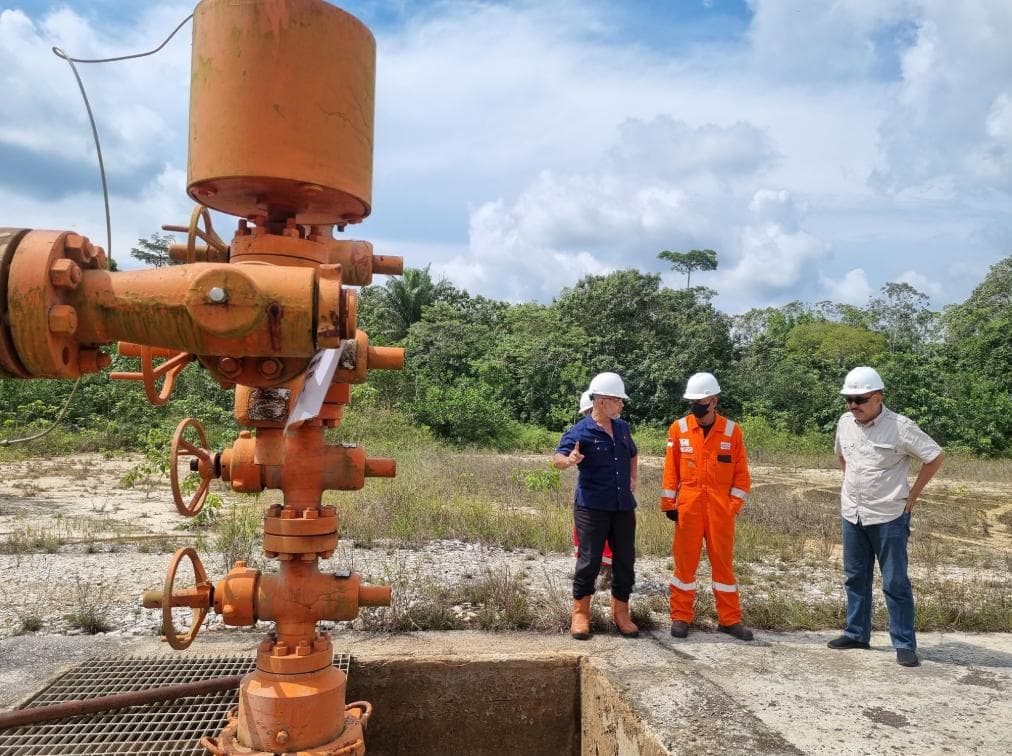
From non-producing assets to national energy.
Idle well reactivation — oil & gas wells not currently producing but still viable for restart, based on technical, reservoir, integrity, surface-facility, and economic evaluation.
KSOT — Operations & Technology Cooperation.
PT Sasamu Putra Indonesia is the first company executing reactivation under the KSOT concept. Through synergy between the Government, operators/KKKS, partners, investors, and communities, we unlock non-producing oil and gas assets and deliver added value to every stakeholder.
Yang kami hadirkan di lapangan
Six stages from preparation to lifting.
Well pad & access road
Area clearing and drainage, cellar construction, waste tank provisioning, pit construction where required, and site restoration budget after completion.
Rig unit deployment
350 HP rig rental, manpower & accommodation mobilization, safety unit, heavy equipment, rig mobilization and demobilization.
Slickline — optional
Acquire actual well-condition data: temperature, pressure, fluid level, casing/tubing leak screening, and other well-bore condition data.
Stimulation / Acidizing — optional
Clear potential scale or deposits in perforation or borehole to improve production rate: pump service, chemical, mobilization, demobilization.
Perforation / Sand jetting — optional
Re-perforation of legacy productive zones or opening new productive layers via Sand Jetting. Minimum pump pressure ±2,650 psi.
Lifting process
Transferring oil & gas output from the production well to surface facilities using SRV/Pumpjack, HPU, or ESP based on well parameters.
Three lifting technologies for idle wells.
The right artificial lift depends on well parameters — flow rate, depth, fluid type, and location.
Sucker Rod Pump (Pumpjack)
Hydraulic Pumping Unit (HPU)
Electrical Submersible Pump (ESP)
Recommended lift by well parameters
| Well condition / parameters | Recommended system | Technical rationale |
|---|---|---|
| High flow rate, medium-to-deep | ESP | Multistage centrifugal sustains high flow with strong volumetric efficiency. |
| Low-to-medium rate, high viscosity, sand | Pumpjack (SRP) | Positive mechanical motion tolerates heavy oil and sand abrasion. |
| Limited footprint / minimize rod wear | HPU | Long stroke and compact footprint reduce rod wear cycles. |
| Very high gas-liquid ratio | SRP or HPU | Reciprocating systems handle free gas without complex separation. |
| Remote onshore well, simple OPEX | Pumpjack (SRP) | Global industry standard; abundant spare parts and expertise. |